

Kingdom Report
www.kingdomvision.co.za
Week of 11 April 2026
Gulf War Interlude - Summary and Analysis
The inflexion in the war: Compromise or Destruction. America, Iran, Israel, GCC. Economics, war developments, 3 possible outcomes. The emerging new world order.
There is a critical decision that Pres. Trump and America must make at the impending ceasefire negotiations in Islamabad. The key question for America is: How do we get out of this geostrategic disaster we got into in the Gulf war? How do we leave and what do we leave behind.
They have two bad options:
- Withdraw and leave with Iran in control of the Strait of Hormuz and watch from a distance as Iran rises to dominate the Gulf region its resources. This is what prof. Robert Pape of the University of Chicago calls Iran's rise to the status of the fourth world power (along with America, Russia and china).
- Withdraw after bombing Iran back "into the stone age" with their power stations and critical infrastructure destroyed. Which will precipitate a counter attack by Iran on the Gulf nations desalination plants and power plants destroyed. Meaning the destruction of a major portion of the world's oil and gas and other critical resources (helium, sulfur, fertilizers) . Meaning world wide economic depression blamed on America.
I don't know what America plans to do. With Donald Trump deciding the fate of the world there are no rational calculations.
From a scriptural prophetic perspective I can make a case for either decisions.
So let me give you some factors impacted by these events on various nations....
Israel
Israel is the great loser in this Gulf war fiasco. They started the war....others will finish it. While Israel tries hard to censor all news of the destruction caused by the missile barrage from Iran....the results of this disaster will soon be visible.
Internationally the world blames Israel for starting this war. And the world is suffering. Israel will not be forgiven. It will be punished. Sanctions, "apartheid state" accusations, investment boycotts, sports and academic boycotts. We here in South Africa know that story and history. The Gaza destruction already cost Israel the sympathy of the world. This Gulf war will cost it the enmity of the world.
Internally the Israeli population is demoralized and afraid. The very existence of the state of Israel is at stake. The economy is shattered. Israeli's are streaming to overland exits through Jordan and Egypt to get out since flights are restricted. When normal flights resume there will be a major exodus out of the country. The half of the population that are not religious Jews have no 'Greater Israel" prophetic perspective. They came because Israel is a safe place for Jews...until it is not.
The protection of the powerful Israel lobby of politicians and billionaires are visibly losing their influence and power. The majority American population has changed their opinion on Israel. Future American financial support is now questionable.
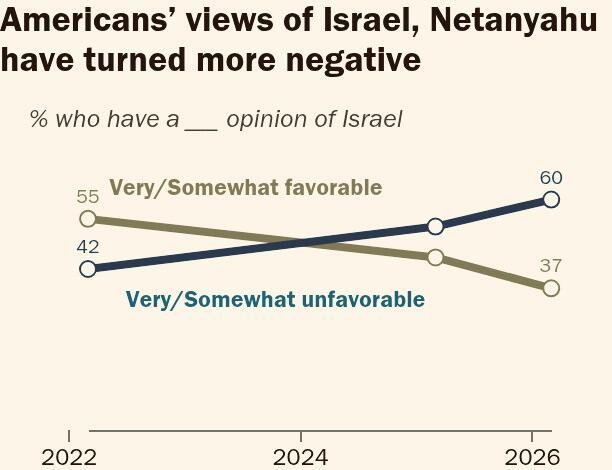
Amid a major war on Iran waged in partnership with the United States, Israel's reputation among Americans has continued to deteriorate, with 60% of US adults viewing Israel unfavorably. That's a hefty 18-point increase from 2022, according to a new survey from Pew Research. Over the same stretch, Israel's "favorable" share cratered by 18 points.
Result: My opinion on pure economic, strategic and social factors....Israel has no long term future. And the short term is equally bad.
America
Is the real major loser in this Gulf war. there was not economic or strategic interest for America in attacking Iran. Iran presented no threat to America. Instead America's image to the world is now irretrievably harmed. The world turns to Russia and China for leadership.
Politically Trump and the Republican party face a disaster in the coming mid-term elections. Trump has destroyed his dominant MAGA coalition that brought him back to power. His presidency is finished.
The Economy
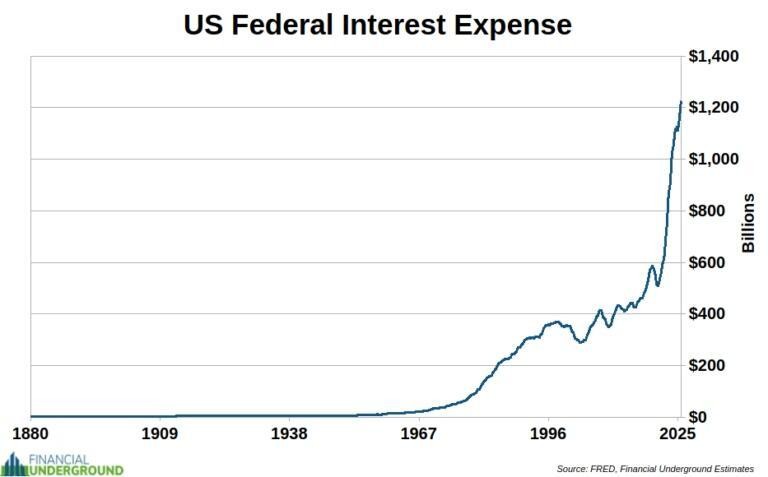
The American economy is in desperate state from a coming dept payment crisis. America needs to roll over and or finance $10 trillion of debt in 2026. The kind of investors that usually bought American treasuries the Gulf states, EU investors, China, Japan...they are not going to have the surplus cash to invest. Below is a chart of America's debt payment obligations...it speaks for itself without my interpretation.
US Losses
Since the start of the Iran war, the US has lost at least 44 aircraft, including the first incident of the US fifth-generation stealth F-35 Lightning II being hit. The list includes four F-15E Strike Eagle (the Wall Street Journal cited a fact sheet stating that the original model costs at least $31 million, while the cost of newer models is close to $100 million), two A-10 Thunderbolt IIs, two Lockheed C-130 Hercules, two Boeing E-3 Sentries, eight Boeing KC-135 Stratotankers, one Boeing CH-47 Chinook, one Sikorsky HH-60 Pave Hawk (damaged), two Sikorsky UH-60 Black Hawks (damaged), four MH-6 Little Bird helicopters, and 17 General Atomics MQ-9 Reapers (each costing over $500 million).
High-value AWACS and multiple KC-135 tankers were damaged by Iranian strikes on regional airbases. In the first four days of the war, Iran hit almost all US military bases (or locations hosting US aircraft) in the Gulf. It struck key US ground radars linked to the THAAD air-defense system, other early-warning radars, and multiple radar and communication nodes.
At Bahrain's Al-Jufair base, two radar domes housing AN/GSC-52B SATCOM systems were destroyed by Shahed-2 drones, according to US press reports.
In the UAE, an area of Al Dhafra base with several satellite antennas was hit, while it is still unclear whether the AN/TPY-2 radar of the THAAD system at Al Ruwais was damaged. In Kuwait, structures at Ali Al Salem base connected to SATCOM systems were damaged, and at least three radar domes at Camp Arifjan were destroyed.
At Saudi Arabia’s Prince Sultan base, at least one strike hit a satellite-communications area where an AN/TPY-2 radar had previously been deployed. The large AN/FPS-132 fixed-face AESA early-warning and long-range anti-ballistic radar at Al Udeid in Qatar also appears to have been struck. Iranian sources further claim damage to another AN/TPY-2 at Muwaffaq Salti base in Jordan, though this remains unconfirmed. In Kuwait, in addition to damage to some structures at the Ali al Salem base that appear to be connected to SATCOM systems, at least three radar domes at Camp Arifjan were destroyed.
Most of these high-value radars – along with aerial refuellers and AEW&C assets – were targeted using ballistic missiles or relatively inexpensive Shahed drones (around $50,000 each).
Result: America has shown itself to the word incapable of defeating Russian in the Ukraine and Iran in the Gulf. So why should Europe and the Gulf states continue to pay America for military bases and military equipment? And does Taiwan and Korea and Japan think that America can or will protect them from China?
American monetary and military hegemony is over. A new world order will emerge from this Gulf war debacle.
Gulf states significantly weakened by US war on Iran – Jeffrey Sachs
Relying on the US for protection has been a debacle. The Gulf states have emerged much weaker than Iran from the Middle East conflict, leading US academic Jeffrey Sachs has said.
Countries in the region made a huge mistake by seeking protection from the US and Israel, Sachs told in an interview on Thursday.
“This has been a disaster for them,” he said, adding that the “clever idea” of the United Arab Emirates as a financial haven and tourism hub “all… fell under bombing right now The US did nothing to help it. I think the Emirates made a terrible mistake in signing on with Israel and the United States saying, ‘This is our side. This is our protection,’” he said.
“But these countries believed that the US is their protector and that the US is their source of NVIDIA chips and data centers and cutting-edge technology. They’re not looking clearly at how the multipolar world is taking shape,” he said.
“They’ve come out way, way behind in all of this. It’s been clear that Iran can devastate them,” he added. “The desalination plants, the bombing of the oil and gas infrastructure, the vulnerability of these countries more generally. It’s been awful.”
Sachs said the Gulf countries “don’t have their own geopolitics… They have been under the US line. But basically, this is a debacle for them.” These nations need to rethink their politics, he added.
“The truth is Iran and the Gulf should be partners. They should be co-investors. They should be at peace.” India knows from its time under British rule that divide-and-conquer is the essence of imperial strategy, Sachs said. “The US has loved to pit Iran against the Gulf, and the Gulf fell for it. Big mistake that needs to be reconsidered,” he said.
For the wider region, the implications are profound.
The Gulf monarchies have had a sobering experience. There will be no return to the comfortable old formula in which security could simply be outsourced to Washington in exchange for money and loyalty. That arrangement, which underpinned the region since the Cold War, has been badly shaken.
Result: Publicly, the Gulf states are unlikely to make dramatic gestures. But privately, their search for new hedges and new partners will intensify. China, South Asia, Russia and, to a lesser extent Western Europe will all become more important in their calculations.
The EU
The Iran war has sent shockwaves through global energy markets – but in Europe, the tremors feel like an earthquake. What was once dismissed as pessimism or “populist scaremongering” is now openly acknowledged at the highest levels of power.
With the Strait of Hormuz blocked, the EU faced a supply shock that promised to cripple manufacturing, ground airlines, hike up the price of food, spike borrowing costs, and send inflation spiralling back to crisis levels.
The crisis nobody can deny anymore
German Chancellor Friedrich Merz has compared the looming burden to the darkest days of recent memory, warning it could be “as heavy as we recently experienced during the Covid pandemic or at the start of the Ukraine war.” Head of the European Central Bank Christine Lagarde has admitted that the long-term effects are “probably beyond what we can imagine at the moment.”
Beyond imagination. That is where Western Europe now stands. And yet for millions of ordinary Europeans, the consequences are already painfully real: higher bills, shrinking savings, and a growing sense that something has gone profoundly wrong.
This is not just another cyclical downturn. It is something deeper – more systemic, more dangerous.
The greatest energy shock in modern history
Fatih Birol, head of the International Energy Agency, did not mince words: “At this moment, we are losing 11 million barrels per day, which is more than the two major oil crises combined… the greatest threat to global energy security in history.” Unlike past crises, this one spared nothing. Oil, gas, diesel, jet fuel – everything was under pressure at once.
The Result" The illusion that Europe could insulate itself has collapsed. The "green energy" fantasy is evaporarting. Everyone realizes what a lack of fossil fuels leads to. The obsessions with "electrons" as energy rather than "molecules" for industry is now apparent. Unfortunately it is too late tor repair the damaged economies.
NATO
The Trump White House is mulling ways to 'punish' NATO allies for not stepping up to support the US Iran campaign, and for staying on the sidelines after Trump's repeat appeals to create a coalition to reopen the Strait of Hormuz.
This could include pulling protective American forces, and US military hardware, from NATO partner countries. It would impact "certain" countries, reports say.
The Wall Street Journal writes in a Wednesday report, "The proposal would involve moving U.S. troops out of North Atlantic Treaty Organization member countries deemed unhelpful to the Iran war effort and station them in countries that were more supportive of the U.S. military campaign. The proposal would fall far short of President Trump’s recent threats to fully withdraw the U.S. from the alliance, which by law he can’t do without Congress."
Result: NATO is finished. It was already fatally wounded from the obvious conclusion that NATO has lost the war against Russia in Ukraine. Now the failure to join Trump in his war of choice against Iran makes Trump ask the obvious question "So why do we need Europe, what have they done for us lately?"
What Now? 3 Scenarios
Scenario 1: A prolonged ceasefire
Let’s assume the pause in hostilities lasts months – or even years. That’s entirely plausible: even if a formal peace deal doesn’t materialize, the ceasefire could simply be extended over and over again.
In that case, the top priority for the Arab states will be building a new generation of air defense. The blueprint is fairly clear: rely on cheap, mass-produced interceptors, whether ground-based (such as Russia’s Pantsir) or air-launched (like APKWS). Both Arab states and Israel will likely focus on this, alongside replenishing their traditional air defense stockpiles.
None of this solves the core problem. The geography of the Gulf makes full protection impossible. Across more than 500 nautical miles (about 1,000 km) – like something out of an old arcade shooter – every shipping lane is within Iran’s reach. Along the coastline, ports, factories, desalination plants, oil storage facilities, data centers, hotels, and skyscrapers sit exposed like targets at a shooting range. Defending all of that from the sea is extremely difficult, and for the time being, the Arab states will likely choose to pay for safe passage.
At the end of the day, they don’t really care who provides that security umbrella. They used to pay the US; now they’ll pay Iran. The price isn’t even that steep – reportedly around $2 million per supertanker, which is just 2-3% of the value of the oil onboard. And ultimately, the buyers will foot the bill anyway.
In the East, one of the highest marks of a wise ruler is the ability to impose tribute on neighbors and make them acknowledge your authority. That principle is well understood in both Iran and the Arab world. Ironically, the US and Israel may have helped bring about a new regional order that actually fits local political logic.
Now Washington and West Jerusalem will face a long, uphill battle to rebuild their influence – and any move they make will be viewed with skepticism by Arab states: what if it all falls apart again? The alpha wolf missed his mark.
Scenario 2: Renewed escalation
It’s entirely possible that in two weeks the war could flare up again – potentially with even greater intensity. Iranian negotiators could be targeted again, triggering an earlier collapse of the ceasefire. Still, we see this as relatively unlikely: despite the considerable military capabilities of the US and Israel, they currently lack a clear path to decisively defeat Iran through conventional means.
Realistically, short of a nuclear scenario, the coalition has two main options.
The first is a campaign of intensive strategic bombing aimed at “bombing Iran back into the Stone Age.” That would require US strategic bombers to operate directly over Iranian territory – a risky proposition, as the incident near Isfahan demonstrated. In such conditions, B-52 bombers would actually be more vulnerable than modern fighter jets – they’re as easy to shoot down as civilian airliners, even for relatively outdated air defense systems.
Meanwhile, Iran’s missile capabilities have not only survived but shown signs of recovery and increased operational tempo. And US forces have been unable to seriously disrupt Iran’s drone launch infrastructure (including Shahed-type UAVs). That means any large-scale bombing campaign risks triggering significant retaliatory damage – especially against the oil-producing Arab monarchies – prolonging and deepening the global oil shock and potentially pushing the world toward a financial crisis.
Israel would also be exposed. According to a JPMorgan report citing the Jewish Institute for National Security of America, the success rate of Iranian strikes on Israeli territory has surged – from 3% at the start of the war to 27% by late March and early April – largely due to the strain and depletion of Israeli air defences.
The second option – a large-scale ground operation, either along Iran’s coastline or against Iranian-controlled islands – comes with all the risks of air warfare plus inevitable heavy casualties. The upside? Essentially none. Limited amphibious raids would achieve little, while a full-scale invasion aimed at regime change is simply not feasible.
None of this means escalation is off the table. It means that before escalating, US and Israeli leadership would have to solve the same equation they faced at the start of the war – but now with far fewer unknowns. Iran’s resilience, its military capabilities, and the extent of US-Israeli international isolation are now much clearer.
If shipping through the Strait of Hormuz resumes and is then disrupted again by US or Israeli action, they would be widely seen as responsible for triggering a global economic crisis.
Scenario 3: Low-level clashes under Iranian control of Hormuz
This is essentially a variation of the first scenario – and, in my view, the most likely one. In fact, it already appears to be unfolding: Iran is accusing Israel of violating the ceasefire with new strikes and is threatening (and likely preparing) to retaliate.
If traffic through the Strait of Hormuz continues more or less uninterrupted, a pattern of ongoing tension and sporadic exchanges could become the new normal. Israel carries out strikes (or Iran claims it was attacked); Iran responds by temporarily shutting down the strait for a day or two – maybe launching a retaliatory strike of its own.
After a few weeks or months, this kind of news simply fades into the background – a constant, low-level risk. The region becomes less stable, but the rest of the world largely shrugs – as long as oil and other resources keep flowing out of the Persian Gulf.
Or Iran just decides to finish the Israel threat for always and just launches everything they have after America withdraws and bombs Israel into the "stone age".